



After years of working around fiat-to-crypto purchase flows — payment declines, failed checkouts, frozen transfers, refund questions, wallet-address mistakes, and support cases where users realized too late that a “simple” P2P trade was not simple at all — I have seen one pattern repeat. The pattern is consistent: people rarely get hurt because they do not understand crypto. They get hurt because they underestimate the real-world payment layer around crypto.
That is why I do not like presenting P2P crypto as just another way to buy crypto. It is not the same risk category as using a structured on-ramp. When you buy crypto P2P, you are not only choosing a payment method and a rate. You are taking counterparty risk, payment-finality risk, source-of-funds risk, dispute risk, and documentation risk from a stranger.
I understand the motivation. People want speed, privacy, and fewer forms. But in real operations, less friction in one place often creates more risk somewhere else.
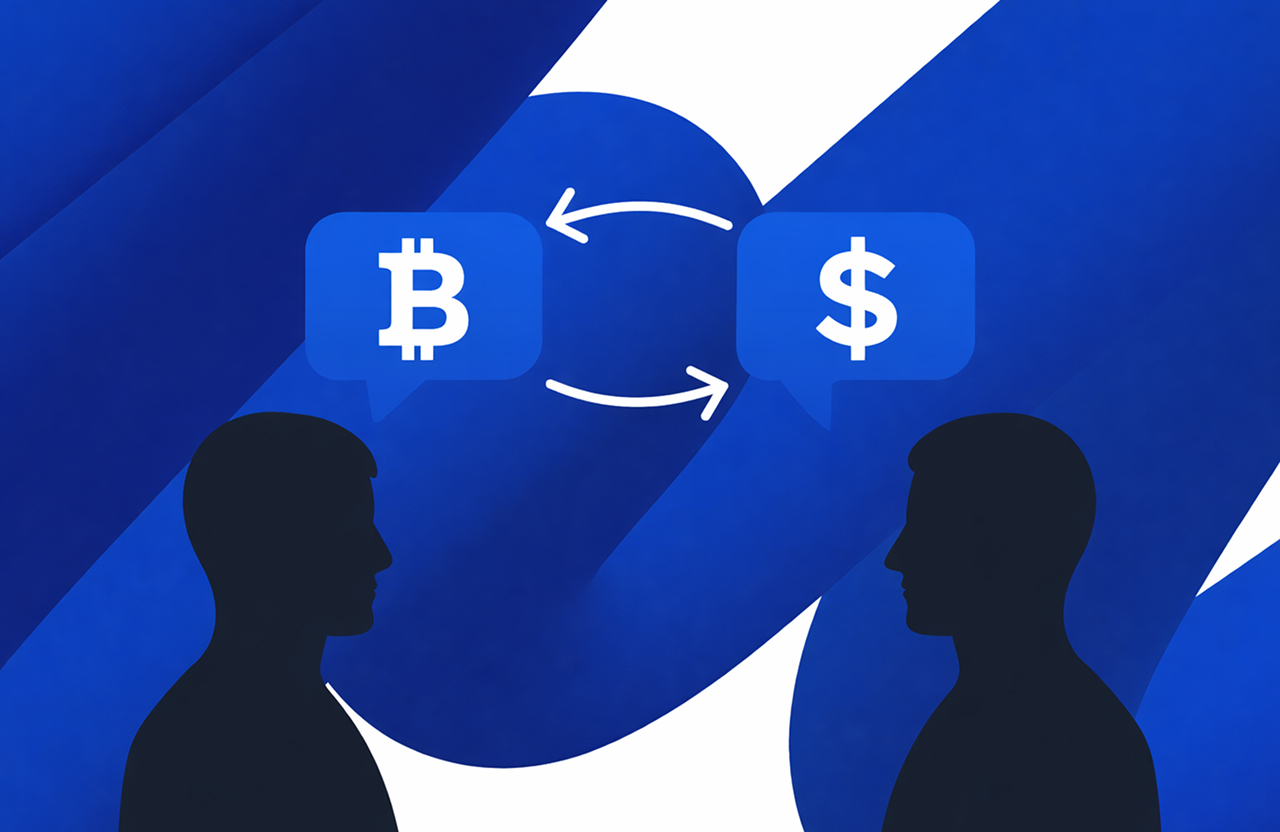
My view is direct: P2P can be useful for experienced traders, but it is usually the wrong default for beginners and casual buyers. A regulated, non-custodial on-ramp such as Guardarian is not risk-free – no serious crypto expert should claim that – but it turns the transaction into a controlled checkout instead of a negotiation with an unknown counterparty.
If your goal is to purchase crypto without turning a payment into a trust experiment, you can buy crypto with Guardarian using a card, bank transfer, Apple Pay, Google Pay, SEPA, PIX, Open Banking, and other supported local methods where available.
Key takeaways:
- P2P crypto is not simply “card vs P2P”. It is a different operating model where the buyer or seller absorbs more of the payment risk.
- Escrow can reduce some crypto-delivery risk, but it does not make fiat payments clean, final, irreversible, or sent by the correct person.
- The biggest P2P risks I see are fake proof of payment, chargebacks, third-party payments, stolen or mule-account money, off-platform communication, and slow disputes.
- “No KYC” is often misunderstood. When fiat touches banks, cards, wallets, or local payment rails, risk checks may still appear. The more accurate concept is low-friction or Low-KYC when a transaction is eligible.
- Guardarian is a safer default for many users because it reduces the number of human trust assumptions in the purchase flow.
Why P2P looks attractive when people want to buy crypto without KYC
Looking for no-KYC is not irrational. Most users are not trying to do anything suspicious. They are tired of long signups, unclear limits, repeated document requests, and exchange accounts they do not want to maintain. They search for “buy crypto without KYC”, “buy crypto without verification”, or “buy bitcoin without verification” because they want the fastest path from fiat to a self-custody wallet.
P2P marketplaces appear to solve that problem. A seller posts a price, a buyer selects a local payment method, escrow holds the crypto, and the trade looks private and flexible. That is the marketing version. The operational version is less comfortable: you still need to trust that the other side pays honestly, uses an account that belongs to them, does not reverse the payment, does not pressure you off-platform, and does not drag you into a dispute.
This is why I prefer the term Low-KYC over “no KYC” for legitimate fiat-to-crypto flows. Low-KYC means the provider may keep the purchase lightweight when the transaction is eligible, while still applying additional checks when payment or risk signals require it. If you need the exact distinction, Guardarian’s guide to what Low-KYC means explains the difference without pretending that every crypto purchase can avoid verification forever.
The mistake is assuming that P2P removes risk because it feels less formal. In practice, informality is often the risk.
The real P2P problem: crypto is final, but fiat payments are messy

The hardest P2P incidents are not the obvious ones where a scammer disappears. They are the ambiguous ones: a payment appears to arrive, the name does not match, a receipt looks real, a buyer insists the bank is slow, a seller releases crypto too early, or a third party contacts the bank later and claims fraud.
From an expert’s perspective, P2P is risky because it connects two systems with opposite logic. Crypto settlement is final. Bank, card, wallet, and local transfer systems can involve delays, reversals, investigations, sender-name mismatches, fraud reports, or account freezes. A P2P trader sits between those two worlds and often has none of the operational tooling a professional on-ramp uses.
That mismatch is why “P2P is cheaper” can be a trap. A slightly better displayed rate does not compensate for a payment that is later reversed, a bank account that gets frozen, or a dispute that consumes hours of screenshots, chat logs, bank statements, and support tickets.
The P2P scam patterns I would warn any new buyer about
1. Fake proof of payment
This is the classic P2P failure mode. A scammer sends an edited screenshot, fake bank receipt, fake SMS notification, or manipulated app screen to make the seller believe payment arrived. Binance describes fake proof-of-payment scams as a specific P2P risk because the victim may release crypto before confirming funds inside the actual bank or wallet account.
My rule is simple: screenshots are not payment. Emails are not payment. Chat messages are not payment. Only settled funds visible inside your own account should count.
2. Chargebacks and reversible payments
Some payment rails allow a buyer to dispute or reverse a transaction after crypto has been released. That creates an asymmetry: the crypto transfer cannot be pulled back, but the fiat side may still be contested. This is why experienced P2P traders avoid risky payment methods and why beginners often underestimate what “payment received” actually means.
3. Third-party and triangle scams
In a triangle scam, the person communicating with you may not be the person paying you. The money can come from a victim of another fraud, while the scammer uses your crypto trade as the exit route. You see incoming money and think the trade is complete. Later, the real payer reports fraud, and your account becomes part of the investigation trail.
4. Stolen or mule-account money
P2P markets are attractive to criminals because they can convert compromised bank balances, mule-account flows, or fraud proceeds into crypto through ordinary-looking trades. The honest counterparty becomes liquidity. This is one of the least understood P2P risks because the user may not lose crypto immediately – they may lose access to their bank account, payment app, or funds later.
5. Off-platform communication
Moving a P2P trade to Telegram, WhatsApp, email, or private calls is a major warning sign. It weakens the evidence trail and gives the scammer room to pressure the victim. In my experience, the moment a counterparty insists on leaving the platform, the user should assume the dispute will become harder to prove.
6. Disputes that are technically “fair” but practically painful
Even when escrow works as designed, disputes are slow and evidence-heavy. You may need exact timestamps, account statements, payment references, screenshots, trade IDs, wallet addresses, and chat records. For a professional trader, that is part of the job. For someone trying to buy $100 of BTC, ETH, USDT, SOL, or another asset, it is a disproportionate burden.
Disclaimer: This article is for informational purposes only and does not constitute financial, investment, legal, or tax advice. Crypto assets are volatile and involve risk. Always do your own research and consider your personal circumstances before buying, selling, or holding crypto.
What the broader data says about the environment in which P2P users operate
Public reporting does not always separate “P2P crypto scams” into a clean, standalone category. These incidents can show up as payment fraud, investment scams, mule-account activity, account takeover, stolen funds, or money laundering. But the broader crypto-crime environment explains why informal P2P trades deserve caution.
Chainalysis reported that stolen crypto funds increased by approximately 21% year over year to $2.2 billion in 2024. TRM Labs estimated that illicit crypto transaction volume was about USD 45 billion in 2024, even while noting that attribution can change as more activity is identified. These numbers are not proof that every P2P trade is fraudulent. They are proof that crypto liquidity sits inside a highly professionalized scam and laundering environment.
That is the context missing from many “best P2P crypto exchanges” articles. They focus on fees, payment methods, and completion rates. Those are useful details, but they do not answer the deeper question: what happens if the payment itself is dirty, reversible, disputed, or made by the wrong person?
Why I would point a beginner toward Guardarian before P2P
Guardarian’s strength is not a loud promise that every purchase is anonymous, instant, and effortless. In crypto, those promises are usually a warning sign. The stronger argument is more practical: Guardarian reduces the number of strangers and unclear steps involved in the purchase.
- The flow is non-custodial: users can receive crypto directly to their own wallet instead of leaving funds on an exchange account.
- The payment options are familiar: credit card, debit card, bank transfer, Apple Pay, Google Pay, SEPA, PIX, Open Banking, and other local methods depending on availability.
- The process is account-light and risk-based: eligible transactions can remain smoother, while higher-risk situations can trigger additional checks.
- The asset coverage is broad: users can buy Bitcoin and many other crypto assets without hunting for a random P2P counterparty.
- The support path is clearer: a failed checkout is easier to investigate than a disputed trade with an unknown person.
That is a more honest and defensible E-E-A-T position: Guardarian is not “safe because crypto is easy”. It is safer than P2P for many users because it removes unnecessary counterparty trust from the purchase.
How to buy crypto through a safer on-ramp flow
- Choose the fiat currency, crypto asset, and purchase amount.
- Select an available payment method such as card, bank transfer, Apple Pay, Google Pay, Open Banking, SEPA, PIX, or another supported local option.
- Enter your wallet address and confirm the correct blockchain network.
- Review the rate, fees, estimated crypto amount, and delivery details before paying.
- Complete payment authentication and any required risk-based verification.
- Save the order ID, transaction hash, and support references until the crypto arrives.
This is also the cleaner answer to “buy crypto with card”, “buy crypto with debit card”, “buy crypto with credit card”, “how to buy crypto with credit card”, “buy bitcoin with debit card”, and “buy bitcoin with credit card”. The best flow is the one where the user can see the final terms before paying and does not need to trust a stranger’s screenshot.
If fees are the concern, P2P is not the only alternative
I understand why users compare P2P with card purchases. Card transactions are fast, but they can cost more than slower payment rails. The safer conclusion is not automatically “use P2P”. The better conclusion is: choose the lowest-risk payment method that still gives you a structured checkout.
For some users, that may be bank transfer, SEPA, PIX, Open Banking, or another local method. For others, a card, Apple Pay, or Google Pay is worth the speed. What I would avoid is choosing a P2P seller only because the displayed rate looks better while ignoring the cost of a frozen account, dispute, or failed payment.
My practical safety checklist before buying crypto
If you use a card or an on-ramp
- Use the official provider website and avoid lookalike pages promising unrealistic no-KYC deals.
- Check the wallet address and blockchain network before confirming the payment.
- Review the final amount, fees, spread, and estimated received crypto.
- Complete 3DS, bank, or wallet authentication only when you recognize the transaction.
- Keep the order ID and transaction details until the crypto is delivered.
If you still use P2P
- Do not communicate outside the platform.
- Never release crypto based on a screenshot, SMS, email, or promise.
- Reject third-party payments unless the platform explicitly supports them and you understand the risk.
- Avoid payment methods with reversal or chargeback exposure unless you know exactly how disputes work.
- Walk away from pressure, urgency, emotional stories, overpayment tricks, or requests to change terms mid-trade.
- Document everything before, during, and after the trade.
- Assume that escrow protects only part of the transaction, not every fiat-side problem.
Final expert view
P2P is not evil by design. It has legitimate use cases, especially in markets where payment access is fragmented and experienced traders know how to manage counterparties. But for the average person trying to buy crypto safely, P2P creates too many places where trust, payment finality, and documentation can fail.
The safer default is a structured, non-custodial on-ramp: clear quote, known checkout, familiar payment method, risk-based verification, support path, and direct delivery to your wallet. That is the route I would recommend before asking a beginner to negotiate with a stranger on a P2P marketplace.
Ready to keep the process simple?
FAQ
Is P2P crypto safe for beginners?
Usually, no. P2P requires users to evaluate counterparties, payment finality, sender identity, evidence quality, and dispute risk. Beginners often focus on the rate and underestimate the payment layer.
Can I buy crypto with no KYC?
Sometimes users can complete eligible lower-risk purchases with fewer verification steps, but “no KYC” should not be treated as a universal promise. Fiat payments can still trigger checks depending on the amount, region, method, and risk signals.
Is Low-KYC the same as no-KYC?
No. Low-KYC means a provider may keep the process lighter for eligible transactions and request more information only when needed. No-KYC implies no identity checks at all, which is increasingly unrealistic for fiat-to-crypto purchases. For a broader market view, see Guardarian’s 85-platform Low-KYC review.
Why does P2P have a higher scam risk?
P2P adds human counterparty risk. Common problems include fake proof of payment, payment reversals, third-party transfers, stolen or mule-account funds, off-platform pressure, and slow evidence-based disputes.
Does escrow make P2P safe?
Escrow helps, but it does not solve every problem. It can hold crypto while a trade is open, but it cannot guarantee that a fiat payment is clean, final, irreversible, or sent by the correct person.
Is buying crypto with a card safe?
Buying crypto with a card can be safe when the provider is reputable, the checkout is clear, payment authentication works, and the user checks the wallet address and network carefully.
Is P2P cheaper than buying crypto with a card?
Sometimes the displayed P2P rate is cheaper. The real cost can include delayed payments, disputes, reversals, frozen bank accounts, and time spent proving what happened. If fees matter, compare bank transfer or Open Banking inside a structured on-ramp before choosing P2P.
Why choose Guardarian over P2P?
Guardarian gives users a controlled, non-custodial fiat-to-crypto flow with familiar payment methods, risk-based verification, broad asset coverage, and a clearer support path. It reduces the need to trust an unknown counterparty.